
How AI Agents Are Revolutionizing Enterprise Workflows in 2025
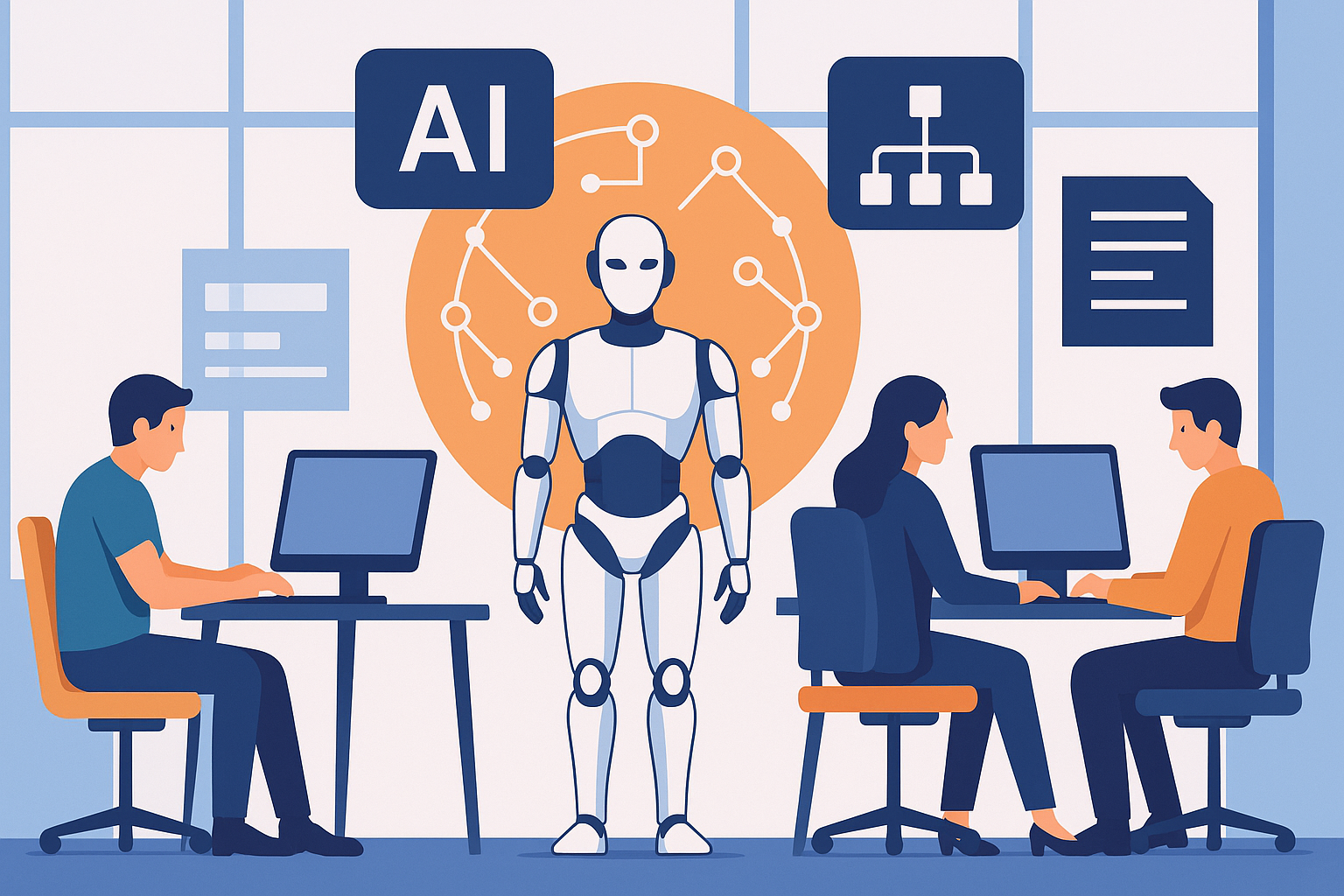
The integration of Artificial Intelligence into enterprise systems is not new—but 2025 has marked a fundamental shift: the rise of autonomous AI agents operating as dynamic collaborators in day-to-day business workflows. These agents are no longer just tools; they are proactive decision-makers, capable of orchestrating tasks across departments, streamlining operations, and even initiating strategic actions.
What Are AI Agents?
AI agents are autonomous software programs that perceive their environment, process information, and take goal-oriented actions—much like a junior employee would. Unlike static bots, they learn from feedback, adapt to context, and often coordinate with other agents to execute complex operations.
In a business setting, AI agents are being used in:
- Sales & CRM: handling lead scoring, outreach, and even negotiation follow-ups
- HR Operations: screening candidates, scheduling interviews, and maintaining compliance logs
- Finance: reconciling accounts, predicting cash flow anomalies, flagging suspicious transactions
- Supply Chain: real-time demand forecasting, logistics coordination, and vendor communication
Why Now?
Several breakthroughs have converged to enable this shift in 2025:
- Large Action Models (LAMs): The next step after LLMs, LAMs are trained not only to generate text but also to perform real-world actions across software environments.
- Enterprise Integration APIs: Tools like LangChain, CrewAI, and Microsoft’s AutoGen now seamlessly connect AI agents with ERP, CRM, and internal SaaS systems.
- Data Governance Frameworks: New standards in AI safety and compliance (especially in the EU and U.S.) have made it easier for enterprises to adopt agents within regulatory boundaries.
Real-World Impact
Take the example of a logistics company using AI agents to manage its dispatch process. Instead of relying on a team of coordinators, an AI agent now:
- Monitors real-time driver locations
- Predicts traffic delays using live feeds and historical trends
- Reassigns delivery routes
- Communicates changes to both drivers and customers automatically
This shift has reduced labor hours by 40% and increased on-time delivery rates by 25%.
Another case is seen in mid-size law firms where agents draft NDAs, summarize court rulings, and monitor legal deadlines—acting as paralegal assistants at scale.
Challenges to Watch
Despite the promise, enterprise adoption is not without risks:
- Over-reliance: Blind trust in AI decisions can be risky, especially when agents operate across systems without sufficient oversight.
- Security Risks: A compromised agent could trigger harmful actions across systems.
- Employee Resistance: Teams may feel threatened by automation, leading to adoption resistance.
To counter this, leading companies are deploying hybrid models—where agents perform first drafts or suggest actions, and human supervisors make the final calls.
What’s Next?
Experts predict that by 2026, over 70% of enterprise workflows will include AI agent participation in some capacity. The move won’t be to replace workers—but to augment them with tireless digital teammates who handle the mundane, freeing humans to focus on strategy, creativity, and relationship-building.
Conclusion
The age of AI agents is not on the horizon—it’s already here. As enterprises rewire their operations to include these intelligent collaborators, the competitive gap between adopters and laggards will widen dramatically. For business leaders, the question is no longer “Should we use AI agents?” but “Where can we not afford not to?”