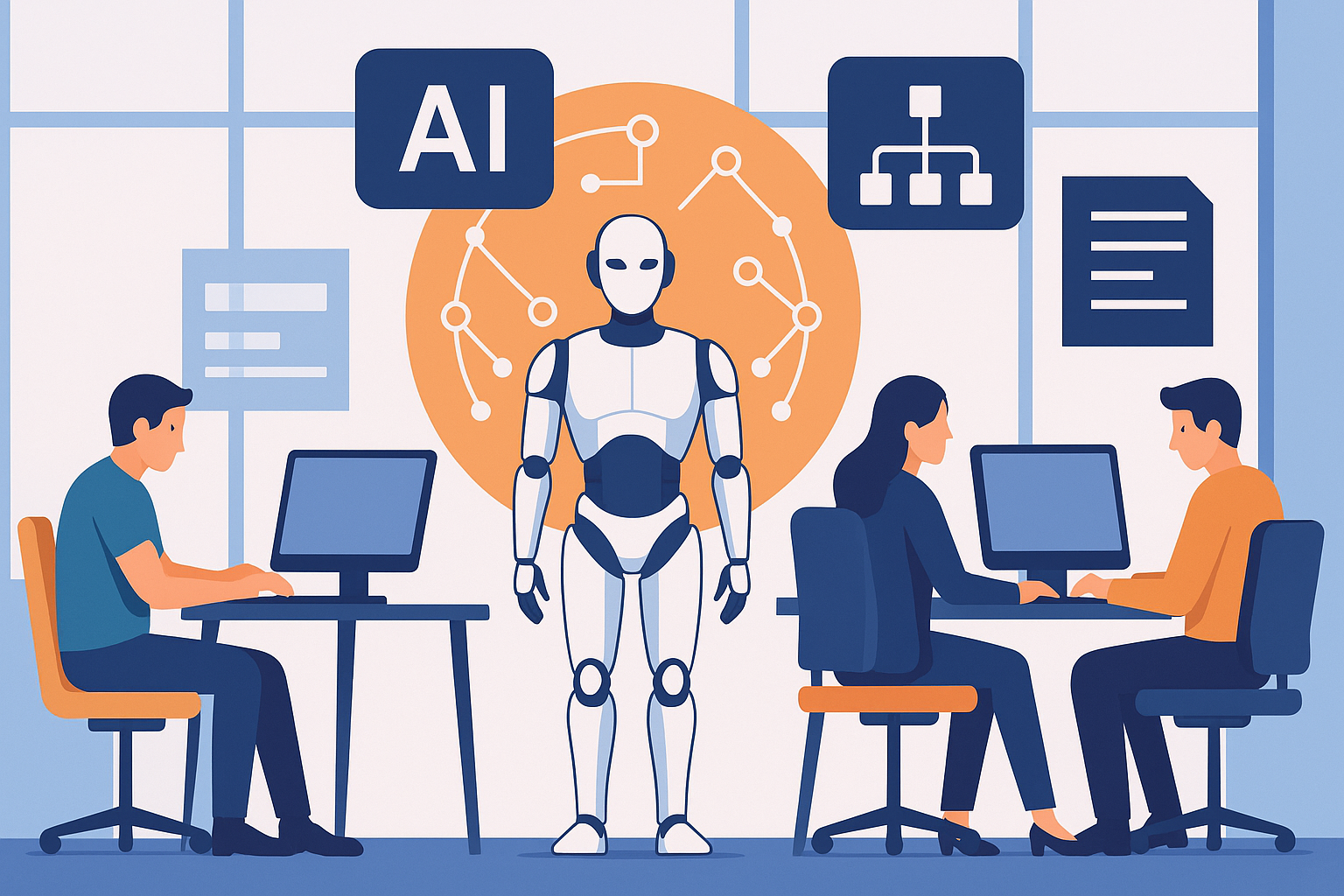
How AI is Reshaping Strategic Decision-Making in Enterprises

For years, businesses have relied on human expertise, historical data, and instinct to make strategic decisions. While data analytics has improved decision-making accuracy, the sheer volume of data available today has made it impossible for traditional methods to keep up. Artificial intelligence is changing this landscape, transforming how organizations assess risks, identify opportunities, and plan for the future.
The application of AI in strategic decision-making is moving beyond simple automation. Businesses are now leveraging AI-driven predictive analytics, autonomous decision systems, and deep learning models to handle complexity at an unprecedented scale. AI-powered tools not only process large amounts of data faster but also uncover patterns that human analysts might miss.
This shift is enabling enterprises to enhance operational efficiency, improve forecasting, and develop more agile strategies in a rapidly evolving market. Below, we explore the key ways AI is revolutionizing strategic business decision-making, along with the challenges and ethical considerations that come with this transition.
AI-Driven Decision-Making: From Data to Strategy
Traditionally, decision-making has been a time-intensive process, often involving multiple stakeholders, extensive research, and manual data analysis. AI, however, is changing this paradigm by enabling businesses to make informed decisions in real-time based on comprehensive data-driven insights.
Predictive Analytics for Market Trends
- AI-powered models analyze vast amounts of historical and real-time market data to forecast trends, giving businesses a competitive advantage in anticipating shifts in demand, pricing, and consumer behavior.
- Retailers, for example, use AI to predict sales trends, helping them optimize inventory levels and supply chain operations.
- Financial institutions use AI-based predictive models to identify economic downturns, assess investment risks, and manage portfolios with greater accuracy.
AI-Driven Risk Assessment and Crisis Management
- AI-powered risk models assess economic, political, and operational risks in real time, allowing businesses to prepare contingency plans proactively.
- AI assists in fraud detection and cybersecurity, identifying anomalies in transactions or network activity before they become serious threats.
- Businesses can leverage AI for real-time sentiment analysis, monitoring news, social media, and industry reports to gauge potential crises before they escalate.
AI in Business Operations: Smarter, Faster, More Efficient
While AI plays a significant role in strategic planning, its impact on day-to-day business operations is equally profound. AI-driven decision systems automate routine processes, optimize resource allocation, and reduce human error, ensuring that enterprises run at peak efficiency.
AI-Powered Process Automation
- AI-driven robotic process automation (RPA) automates repetitive tasks such as data entry, compliance checks, and document processing, freeing employees for high-value strategic work.
- Businesses leverage AI-driven decision-making in customer support, where AI-powered chatbots handle customer queries, process orders, and provide instant assistance.
- AI-enabled workflow optimization tools assess resource allocation, employee productivity, and operational efficiency, identifying bottlenecks and suggesting improvements.
Supply Chain Optimization with AI
- AI-powered logistics models predict disruptions in supply chains, allowing businesses to adjust sourcing and distribution strategies dynamically.
- AI-driven inventory management systems minimize waste by ensuring stock levels align with actual demand, reducing costs and improving profitability.
- Autonomous AI decision-making is enhancing procurement strategies, evaluating multiple suppliers to ensure cost-efficiency, quality, and sustainability.
Enhancing Human Decision-Making with AI
One of the biggest misconceptions about AI in business is that it aims to replace human decision-makers. In reality, AI enhances human intelligence by providing deeper insights, automating low-level decision-making, and reducing cognitive overload.
Augmented Decision-Making with AI
- AI-powered decision support systems (DSS) provide executives with real-time dashboards, scenario simulations, and predictive insights, enabling more informed strategic choices.
- AI tools assist in merger and acquisition (M&A) analysis, evaluating financial models, cultural fit, and risk factors to guide corporate expansion.
- AI enhances boardroom decision-making, offering data-driven recommendations based on market trends, consumer behavior, and business performance analytics.
AI-Powered Personalization in Leadership Decisions
- HR departments use AI to analyze employee performance, predict turnover risks, and develop tailored retention strategies.
- AI-driven leadership analytics help executives refine corporate culture, employee engagement, and organizational structure based on data-driven insights.
- AI models provide real-time feedback on company performance, allowing leaders to course-correct strategies quickly when market conditions shift.
Challenges and Ethical Considerations in AI-Driven Decision-Making
While AI-powered decision-making offers tremendous benefits, it also comes with ethical and operational challenges that businesses must address.
AI Bias and Fairness
- AI models trained on biased data may produce discriminatory or inaccurate outcomes, particularly in hiring, lending, and law enforcement decisions.
- Businesses must implement AI fairness frameworks to ensure algorithms operate transparently and equitably.
Data Privacy and Compliance
- The use of AI for decision-making requires large-scale data processing, raising concerns about user privacy, security, and regulatory compliance.
- Companies must ensure compliance with GDPR, CCPA, and other data protection regulations to protect consumer rights.
Balancing AI and Human Judgment
- While AI can process data faster than humans, it lacks emotional intelligence, ethical reasoning, and contextual understanding.
- Business leaders must strike a balance between AI-driven insights and human intuition, ensuring that AI remains an aid rather than a sole decision-maker.
The Future of AI in Business Strategy
The integration of AI into strategic decision-making is no longer a distant possibility—it is already shaping the future of business. As AI continues to evolve, enterprises must:
- Adopt explainable AI (XAI) frameworks, ensuring decision-making processes remain transparent and interpretable.
- Invest in AI literacy among leadership teams, enabling executives to leverage AI insights effectively.
- Develop adaptive AI systems, allowing businesses to pivot strategies dynamically based on real-time market conditions.
Companies that embrace AI-driven decision intelligence will gain a competitive edge, making faster, smarter, and more informed strategic moves than their competitors.
Final Thoughts: A New Era of Intelligent Decision-Making
The role of AI in business strategy is no longer just about automation—it is about intelligence, adaptability, and innovation. Organizations that harness AI for predictive insights, risk assessment, and operational efficiency will thrive in the new digital economy.
Yet, AI is not meant to replace human leadership but to enhance and support it. The key lies in combining human expertise with AI-driven intelligence, ensuring that decision-making remains data-driven, ethical, and aligned with business goals.
As businesses continue integrating AI into their strategic frameworks, the future of corporate decision-making will be defined not just by data, but by the intelligent systems that make sense of it.